| |
Earliest Beginnings
The hill to the east of Sheffield was granted by William
the Conqueror to William de Lovetot as part of the
Manor of Hallamshire. By 1200, the de Lovetot family
had built the first church in the village and founded
a wooden bailey castle.
The De Furnivals, Lords of
Hallamshire during the thirteenth and fourteenth centuries,
rebuilt the castle in stone and granted a charter
to the town of Sheffield in 1297. By the early 1500’s,
the Talbot Lords had established their control over
the vast parklands that included the park, marshy
areas, mills, and ponds which provided an abundance
of waterfowl for the Lord’s table. In addition
to the plentiful supply of deer from the 2,462 acre
deer park, the natural resources of the area were
abundant.
15th Century
In 1406, John Talbot, the first Earl of Shrewsbury,
acquired, through his wife, Sheffield Castle and its
estates, which included the deer park and a hunting
lodge on the site now known as Manor Lodge. John Talbot
served in various positions in Wales and France during
the Hundred Years War. He also served as Lieutenant
of Ireland several times, was taken prisoner in the
Battle of Patay in 1429 and released in 1433. He suppressed
a revolt in 1436 and was rewarded by Henry VI with
the title Marshal of France. In 1442, he was created
Earl of Salop – Shrewsbury was the name he used
for the title. He was eventually killed in a battle
in 1453.
16th Century –A
Great Manor House
In 1516, a grand manor house was constructed, befitting
the rank of the family. Sheffield Manor Lodge, as
we know it today, was primarily built as an alternative
residence to the Castle by the fourth Earl of Shrewsbury,
George Talbot. It was far more comfortable and the
air was fresher on top of the hill in the midst of
the great deer park.
In 1530, Thomas Wolsey was charged
with high treason and arrested in York. On his long
journey back to London to stand trial, he stayed at
Manor Lodge as a guest of the fourth Earl for 18 days.
Despite being frail and ill, Wolsey was forced to
proceed and died two weeks later at Leicester Abbey,
never reaching London or the fate that had awaited
him. A legend has arisen that he died of dysentery
due to the unsanitary arrangements at Sheffield Manor
Lodge. However, this is unlikely as the indoor garderobe,
still visible today, was very advanced for the times.
The sixth Earl of Shrewsbury, another
George Talbot, married the rich and powerful Bess
of Hardwick. Possibly due to her influence, he significantly
enlarged and improved Manor Lodge and other buildings
on the site. By the 1570-80’s the Manor was
a great country residence and their preferred abode,
boasting beautiful views of the deer park and surrounding
countryside. In 1574,Talbot added the three-storey
turret house that still stands today. His splendid
home was to be shared with Mary Queen of Scots and
her entourage who were held between Sheffield Manor
Lodge and Sheffield Castle for 14 years, by order
of Elizabeth I.
George Talbot was the quintessential
industrialist, investing heavily in local mining,
cutlery, and manufacturing. He eagerly mined the park
and surrounding areas for seams of ironstone, veins
of coal, wood for charcoal, gritstone for grinding
wheels; rivers turned these wheels of industry. As
Lord of the Manor, he also regulated the burgeoning
cutlery industry by issuing trademarks and thus played
a significant role in an emerging industry that was
to be at the heart of Sheffield’s future prosperity.
17th Century
Turmoil
Gilbert Talbot, the very wealthy, well-educated, seventh
Earl of Shrewsbury, led a very turbulent life and
was married to his step-sister Mary at an early age.
Gilbert and his family were in contention over their
father’s complicated will for the rest of their
lives. At one point, his own brother tried to kill
him with a pair of poison perfumed gloves! Gilbert
continued his father’s legacy of industrialisation
that provided him with the means to extravagantly
entertain, extensively travel and invest heavily in
art.
But Gilbert’s earldom, like
his father’s, was surrounded by dangerous royal
intrigues circling closely around his family connections.
Gilbert’s youngest daughter, Alethea, married
the penniless but well-titled Thomas Howard. Upon
the death of Gilbert, and his brother the following
year, the Talbot estates were divided amongst Gilbert’s
three daughters. The property containing Manor Lodge
and one-third of the estate assets went to Alethea,
and thus into the hands of the Howard family. The
Norfolk’s were generally absentee landowners
who profited greatly from the industrial age that
was overwhelming Sheffield. Records show that by the
1650’s the lodge was partly abandoned, trees
had been felled in the Park and the land built on.
18th Century
Decline
The eighth Duke of Norfolk, Thomas Howard, partially
demolished the abandoned manor complex, sold off stone
and timber and removed what little furnishings remained.
Parts of the manor buildings were let to tenant farmers,
craftsmen, and labourers. John Fox, a potter, had
a pioneering industrial scale kiln in the remains
of the Wolsey tower. The decline of the grand house
continued and in 1793 a gale force wind destroyed
the last of the two entrance towers to the manor on
the hill.
Sheffield continued to grow in
response to thriving industrialisation. Housing demands
for workers increased, mining automation was introduced,
and metal railroads were invented. The Manor Lodge
site was at the forefront of this revolution as John
Curr, an outstanding mining engineer and inventor
of the metal railroad, worked for the Duke of Norfolk.
By the end of the 18th century,
the eleventh Duke of Norfolk returned to Sheffield
with a plan to improve the town. His plan called for
new housing, a fashionable quarter, rebuilding the
old markets and a new street plan. Only part of his
plan was ever implemented.
19th Century
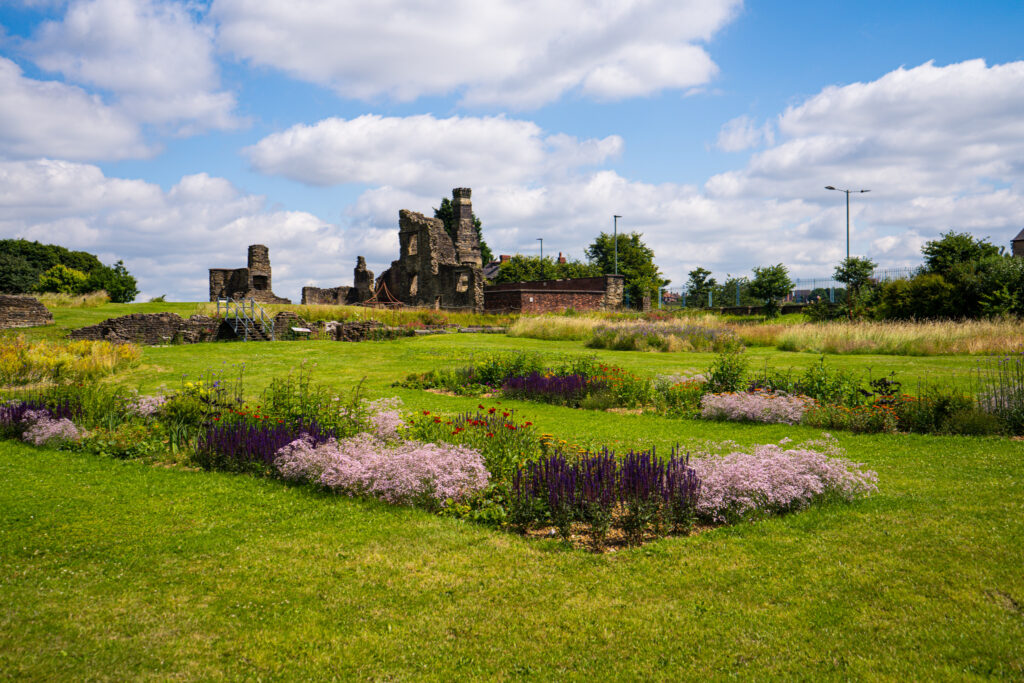
Although much of the park was farmland by the 19th
century, Manor Lodge, as a whole, had been transformed
from rural to industrial. The cottages built the previous
century were still in use, a pub, “The Norfolk
Arms”, was built into the ruins, a mine shaft
was sunk just beyond Wolsey’s tower and farm
buildings occupied the hillside below. A Methodist
chapel was even erected in the former inner
courtyard. At this point in Sheffield’s history,
most people lived in very harsh conditions –
overcrowded, overworked, underfed - typical of the
industrial age. Not surprisingly, a devastating
cholera epidemic hit Sheffield in 1832, killing as
many as 400 people within five months!
Late in the Victorian era,
Henry, the fifteenth Duke of Norfolk, renewed interest
in reclaiming Sheffield and specifically, Manor Lodge.
It was under his direction that the turret house was
restored and most of the post 16th century buildings
within the manor grounds were demolished. He founded
parks and gardens for the people of Sheffield, bequeathing
a large sum of money to the town in 1909.
20th Century
By 1907, the ruins had been cleared of occupants and
fenced off. Between the 1930’s and the 1950’s
much of the surrounding land was sold off and the
housing estates that currently surround the property
were built.
In 1953, The Norfolk Estate granted
a 999 year lease of Sheffield Manor Lodge to the City
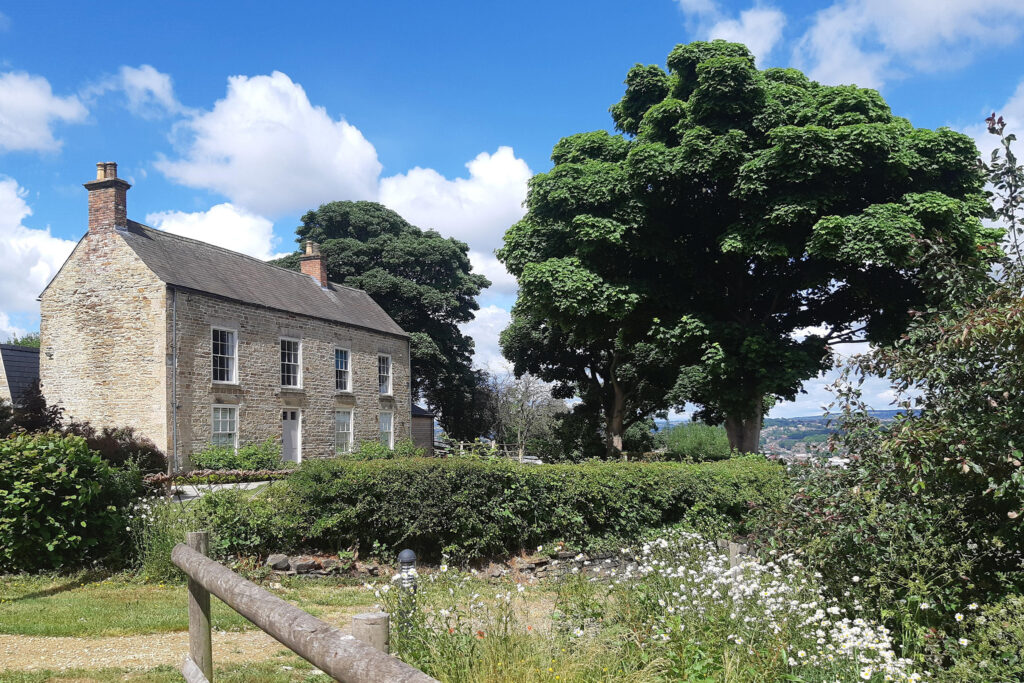
of Sheffield. In 1968, a home was built on the site
for the resident stonemason who worked on stabilising
and restoring the ruined manor house. Archaeological
digs were carried out by the City Museums from 1968
to 1980 to uncover the site’s history. These
revealed its long and complex history and uncovered
the only pottery kiln to have been found in Sheffield.
261 boxes of finds plus other larger pieces are currently
being stored by Sheffield Galleries and Museums Trust.
The finds are predominantly pottery but there are
also a variety of artefacts of metal, bone, leather,
glass and miscellaneous building materials of medieval
to 19th century date.
In the 1980’s, the turret
house was opened as a museum centred around the finds
but a lack of funding meant it had to close. In 1995
a Friends group was established to generate support
for restoration work, develop visitor facilities and
manage open days.
|
|